Subscribe By Email:

Delivered by FeedBurner

United for Medical Research, a coalition of leading research institutions, patient and health advocates and private industry have joined together to seek steady increases in federal funding for the National Institutes of Health.

United for Medical Research (UMR) applauds the roughly 3% percent increase the President has proposed in the FY2011 budget for the National Institutes of Health (NIH).  An increase of such an amount in this challenging budget environment is a true testament to the President’s ongoing commitment to science and biomedical research.  Robust funding for the world’s leading source of biomedical funding drives better health and a stronger economy.

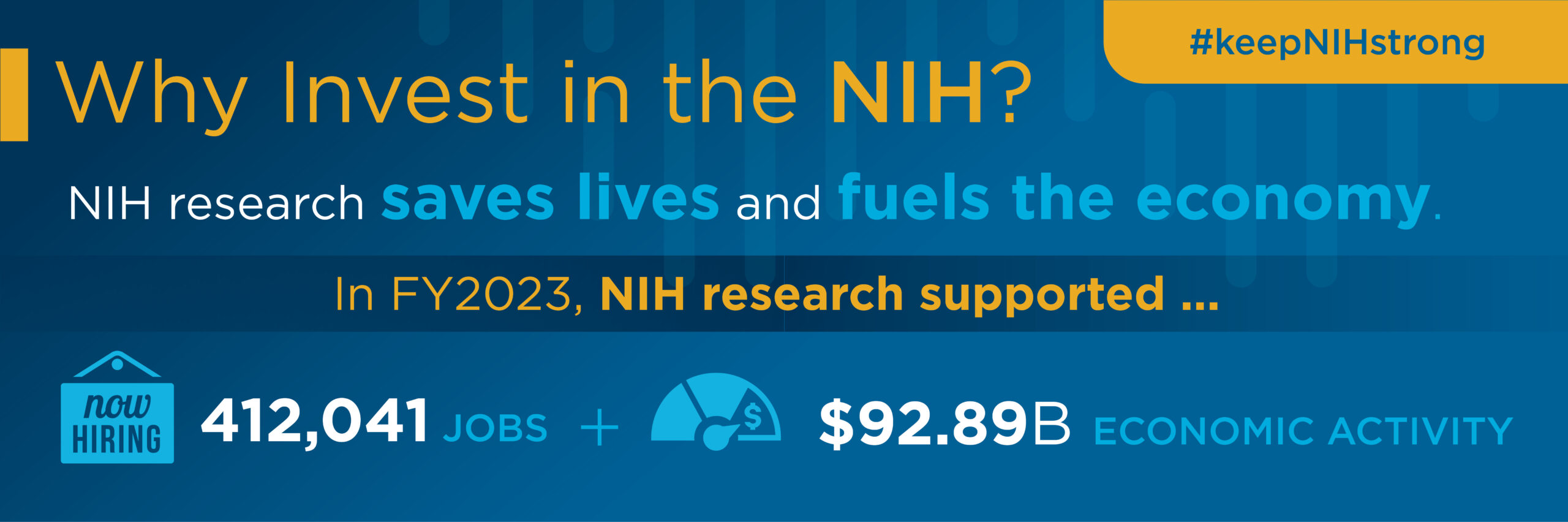
Each year, NIH funding directly supports 325,000 jobs in U.S. research facilities in all fifty states and the U.S. territories, and indirectly supports thousands of additional jobs in companies that supply and support research labs and research employees.   NIH funded research is also a main source of the discoveries that some of the nation’s most significant employers – the biotech and pharmaceutical industries – build upon to produce the next generation of treatments and cures. 

NIH supported research has produced a revolution in biomedical science.   Scientists and clinicians are now fighting disease using newly gained knowledge about biological structures and functions.  Combined with the increasingly rapid evolution of new technologies supporting and accelerating scientists’ work, scientific progress is shrinking the average time between basic discovery and new treatments, and enabling higher quality health care and less waste.

Today’s budget announcement is a promising continuation of the President’s commitment to this important field.   But more can be done to  ensure the nation is able to full reap the benefits of this historic opportunity in biomedical science.    In the months and years ahead, UMR will continue to make the case for strong funding for the NIH to ensure we deliver on that promise for our national economy and countless patients who count on the results of biomedical research.

{ Comments on this entry are closed }

President Obama highlights ‘basic research’ in SOTU

January 29, 2010

In his first State of the Union address, President Obama took the opportunity to once again link America’s investment in basic research to the country’s overall innovation agenda:
“…we need to encourage American innovation. Last year, we made the largest investment in basic research funding in history — an investment that could lead to the world’s cheapest solar [...]

Read the full article →

Reuters: Dr. Collins to emphasize health at NIH

January 27, 2010

In a recent interview with Reuters, NIH director Dr. Francis Collins said that the agency will turn its attention this upcoming year to how investment in biomedical research impacts clinical science around the country.
The NIH is the single largest source of biomedical research funding in the world, and throughout its history, it has been the catalyst for academic, clinical, [...]

Read the full article →

Recovery Act creating jobs, funding exciting science

January 22, 2010

A new UMR report documents how Recovery Act funding of medical research through the NIH is creating and preserving jobs, laying the foundation for industry growth, and helping to reduce long-term health care costs. Investing in Recovery and Discovery illustrates these benefits through real-life stories of research scientists and their Recovery Act-funded work.
According to Dr. Steve Fluharty, Vice Provost for Research [...]

Read the full article →

UMR releases a Recovery Act success story

January 20, 2010

This week UMR released a detailed report on how Recovery Act funding of medical research through the National Institutes of Health (NIH) is at work across the country in the service of better health and a healthier economy.
Investing in Recovery and Discovery documents how the $10.5 billion infusion in 2009 and 2010 in biomedical innovation is creating [...]

Read the full article →

New report finds decline in biomedical research funding

January 15, 2010

A new study published in the Journal of the American Medical Association  reports that the rate of increase in  research funding slowed between 2003 and 2008, and in absolute terms, the level of funding from the NIH and associated  industriesdecreased by 2% in 2008.
The authors of the study, led by neurologist Ray Dorsey M.D., used [...]

Read the full article →

Time magazine: The age of epigenetics has arrived

January 11, 2010

In Time magazine’s cover story this week, John Cloud explores the potential of epigenetics.
The article highlights the past and current biomedical research projects pushing this important issue in biology forward, and concludes with the statement that “the age of epigenetics has arrived.”
Researchers in the epigenetics field study changes in gene activity that get passed down [...]

Read the full article →

NIH announces new Recovery Act grants

January 6, 2010

The National Institutes of Health (NIH) rang in 2010 with exciting new opportunities for biomedical researchers.  On December 28, the NIH announced new three-year grants made possible through last year’s American Recovery and Reinvestment Act.
According to the NIH, the grants fall under a program entitled “NIH Director’s Opportunity for Research in Five Thematic Areas” and will be awarded to researchers proposing to develop [...]

Read the full article →

Gephardt and Brennan Advocate for Medical Research at the Aspen Health Forum

October 23, 2009

During the annual Aspen Health Forum, the Hon. Dick Gephardt and the CEO of Astra-Zeneca, David Brennan, joined forces to highlight the importance of funding medical research.
Both research advocates spoke of the need for translational research (i.e. the use of basic scientific discoveries by pharmacetical companies and biotech companies) and the need for better science [...]

Read the full article →